



The most common use and need for portable generators is for backup power. With a growing number of natural disasters occurring every year, preparing for an outage is a more prudent investment than ever. When equipping yourself for an emergency, there’s no ideal season for buying a backup generator: The time to buy is before the lights go out. If you wait until you need one, you may find yourself picking the best available option, rather than what you ultimately want or need.
Of course, portable generators have other applications too. They’re useful anywhere you’re out of reach of an outlet—places like construction sites, tailgating, camping, barbecues, and at events like parades and fairs.
The Best Portable Generators
Editors’ Note: We reviewed our picks of the best portable generators on January 15, 2025. In our most recent update, we removed one pick, the Westinghouse WGen7500, which is no longer available at most retailers. (Though you can get one used on Amazon.)
We are preparing for a new round of testing, and will update our list with new options soon. In the meantime we stand by these eight tried and true recommendations.
The Expert: I’ve been testing generators at Popular Mechanics for 5 years. In that time I’ve tested dozens of units, both big and small. Aside from testing, I also have experience using these devices to power campers and RVs, off-grid. Additionally, over the years in my rural homes, I’ve had to install both manual and automatic transfer switches for using generators as backup power sources for multi-day power outages.
What You Need to Know About Portable Generators
Before running out to buy a portable generator, it’s important to think about how and where you’re going to use it. There are often laws, rules, and restrictions regarding their use in residential homes, with homeowners associations, at campgrounds, or on construction sites.
Picking the right one means you’ll be able to power up the appliances or equipment you need. Picking the wrong one, or using it improperly, could damage the generator or what is connected to it, at best. At worst, it could be dangerous, posing a risk of fire, electrocution, or carbon monoxide poisoning.
How Generators Work
Generators consist of two major components: an engine and an alternator. The engine turns the alternator, producing AC (alternating current) power that goes through a voltage regulator to deliver 120 volts or 240 volts, as required. AC power is what is distributed and used in our homes, so we can power just about anything we can plug in at home using a generator.
Types of Generators
Fuel Options
Most portable generators are powered by gasoline, which is the most commonly available fuel. However, when using generators for emergency power, their infrequent use presents some issues to consider. The first is that when big, catastrophic storms hit and power outages span days, gas stations may have trouble meeting the demand and there may be long lines.
The second issue has to do with the infrequent use of backup generators, which may sit for months to years between use. Gasoline sitting in a carburetor will slowly evaporate over time, leaving gummy deposits that can block fuel from getting through, making it difficult or even impossible to start your generator without servicing.
You can avoid this by closing the fuel valve and letting the generator run until it stalls, using up the fuel left in the carburetor. Over time, gasoline can oxidize or go “stale,” losing combustibility. It may also absorb water, which can then corrode fuel tanks and other metal components in the fuel system. Starting a generator regularly, as well as treating fuel with a stabilizer, can help fight these issues.
Ethanol-free gasoline, available at some gas stations, is also less susceptible to degradation over time than standard 87-octane pump gas, though it’s still a good idea to mix the fuel going into your generator with stabilizer.
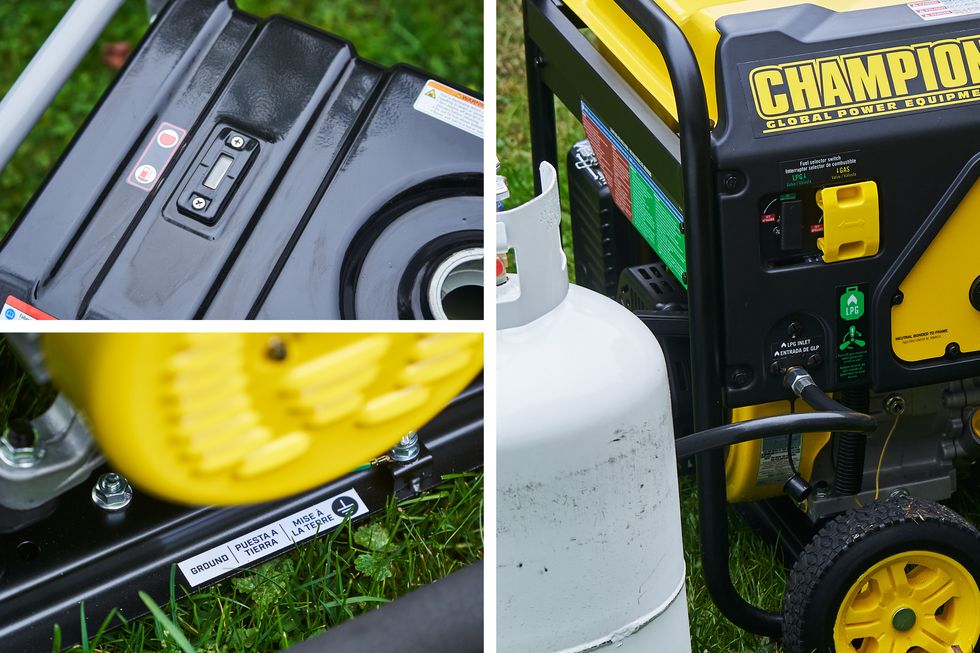
Dual-fuel generators can run on gasoline or liquified petroleum gas (LPG), commonly known as propane. Switching between the fuels is simple, and you won’t be tied into the availability of one type of fuel.
There is a bigger advantage to propane, though: It is very stable when stored for long periods of time. It won’t go stale, and won’t gum up carburetors from sitting. Plus, some homes that use propane for other purposes may already have large storage tanks on the premises, foregoing the need to make repeated trips out for fuel.
The one downside to propane is that it creates fewer BTUs (British Thermal Units, a measurement of energy) than the same amount of gasoline. So, a generator running on propane will have slightly reduced starting and running watts. On the plus side, though, it will also run a little quieter than those that run on gasoline.
While they are few and far between, you may also find generators that run on natural gas. There are also propane-powered generators that can be converted to run natural gas.
Does Your Generator Need to Be Grounded?
If you’re powering appliances, tools, or other devices by plugging them directly into the standard outlets on the generator, the answer is no. If the generator is being used to power circuits in your home, maybe. It’s always best to consult the operator’s manual, a licensed electrician, and/or township ordinances with your local building officials—some localities may have requirements that differ from the NEC (National Electric Code).
Electrical circuits need to be grounded in order to operate devices safely, so that any current that shorts out, or has a fault, is directed to the ground, i.e. the actual, literal earth, so the user doesn’t become the conduit to “ground.”
There are two ways that generators are grounded: neutral bonded and floating neutral. Neutral bonded means that the neutral wire is bonded, or connected, to the generator frame. With a floating neutral, the neutral is not connected to the frame. In the latter case, the generator should be grounded by connecting the ground terminal to a grounding rod driven into the ground.
Generators with GFCI (Ground Fault Circuit Interrupter) outlets, when used to power circuits in your home, require a neutral switching, manual transfer switch, and need to be grounded by connecting the ground terminal to a ground rod, driven into the soil. Neutral switching transfer switches are also referred to as three pole transfer switches.
Generator Safety
A generator, or anything with a fuel-powered engine, should never be operated in a closed space, like a garage or shed. Exhaust gasses contain carbon monoxide (CO), an odorless, colorless gas that can poison and kill people. Most manufacturers offer models that will shut down when they detect carbon monoxide building up, which prevents them from running in closed spaces.
Do not run a generator in a garage with the door open, or in front of the garage with the door open—carbon monoxide can still become trapped in the garage and slowly make its way into the home. For this reason, generators should be run outside, at least 20 feet from the house, away from windows and doors, with the exhaust blowing away from the house.
Sizing a Generator Correctly
It’s important to know what you intend to power with a generator in order to choose the right size. Manufacturers list two figures for generators: starting watts and running watts. Starting watts includes the initial surge required to start appliances or tools with powerful electric motors or compressors. Once started, these devices require far less power to run continuously.
Many manufacturers have a chart with estimated power requirements for common appliances and tools to help you figure out what you need. For a more precise measurement, you can also calculate the figure yourself by adding up power consumption of specific appliances and adding them together. To calculate watts, multiply voltage (usually 120 volts) by the amps (amperage) required to run the appliance (usually found on a tag attached to the appliance). Do this for each item the generator will power.
How We Selected The Best Portable Generators
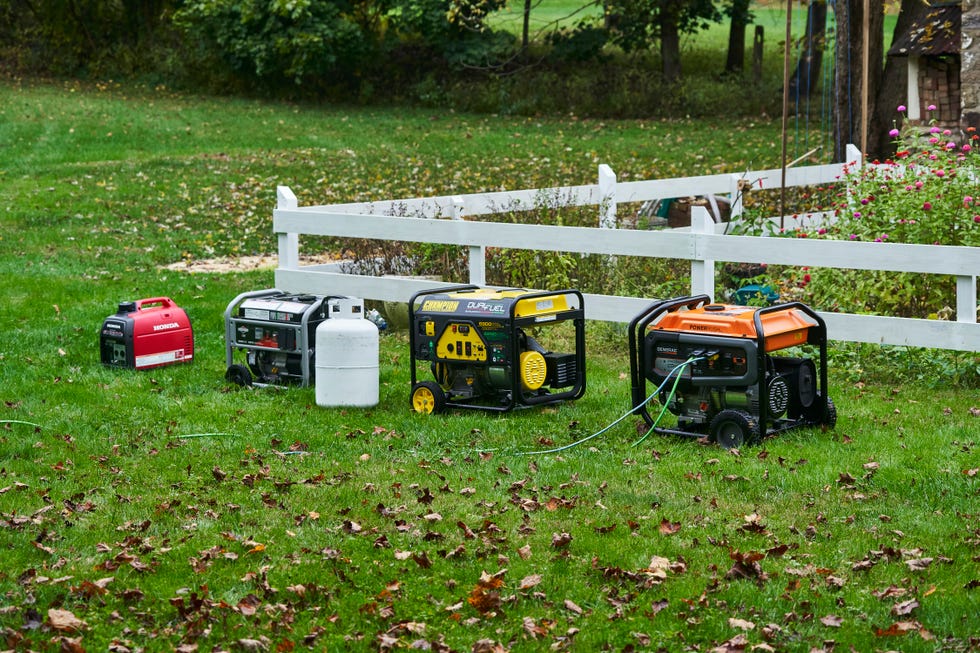
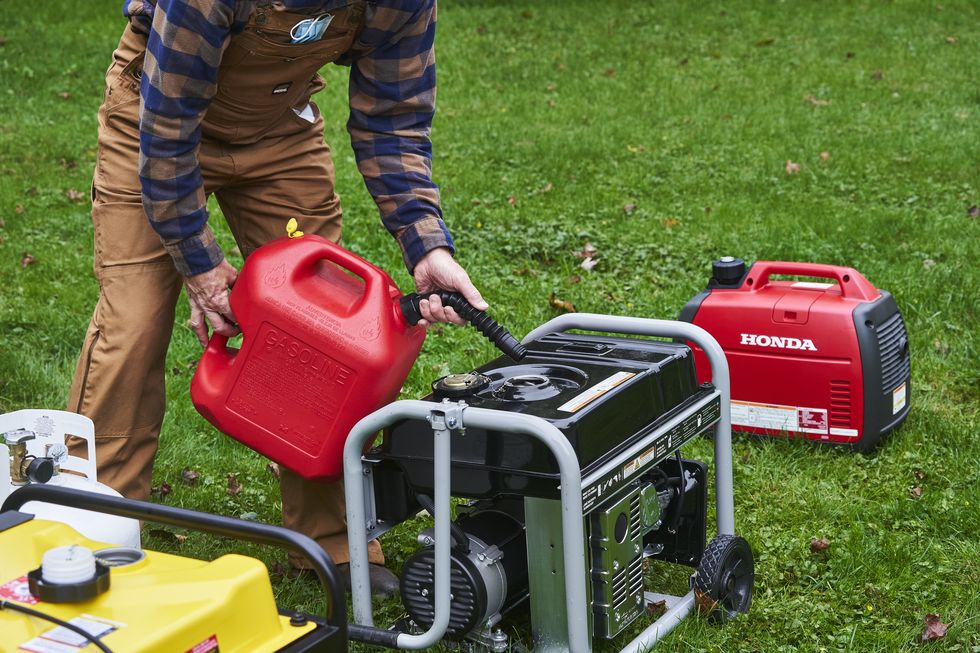
We researched popular features, scoured consumer reviews, and talked with product engineers to pick the generators in this guide. Testing these models was based on our experience using generators for backup power with and without transfer switches, on construction sites to run power tools and equipment, as well as running sound systems and lighting at outdoor events.
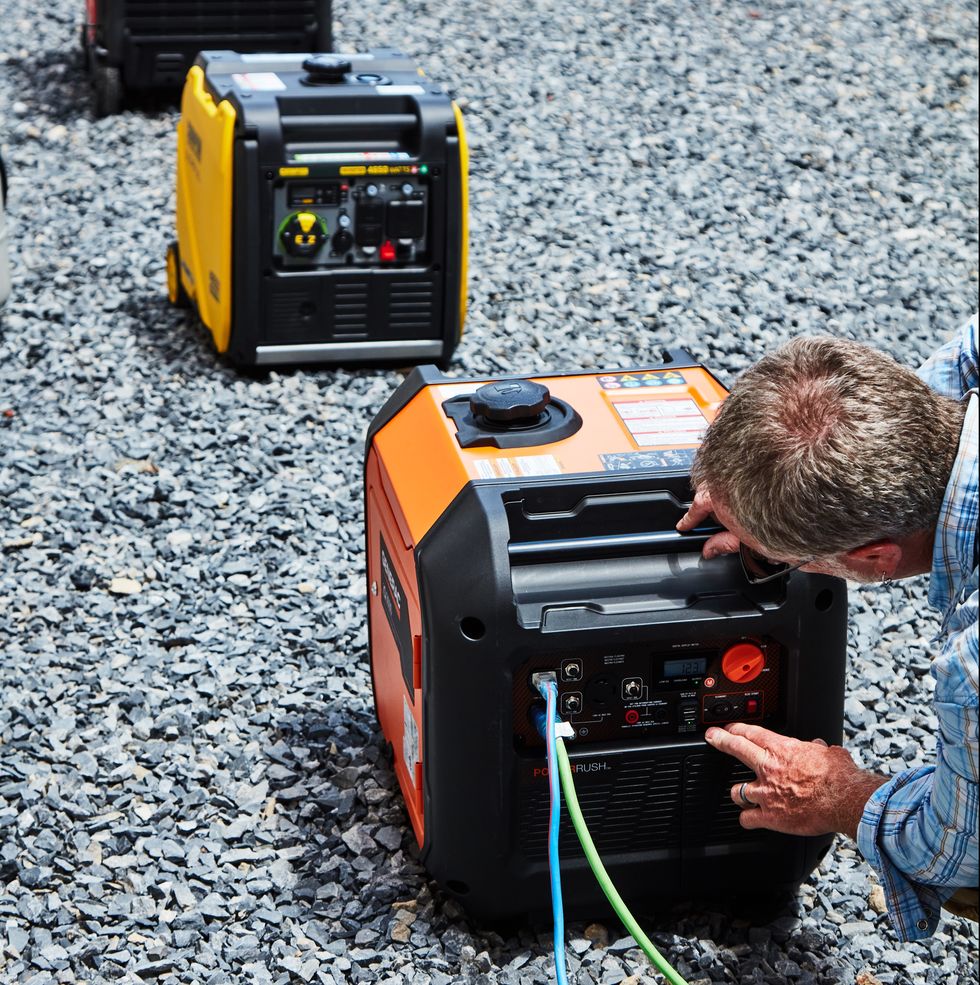
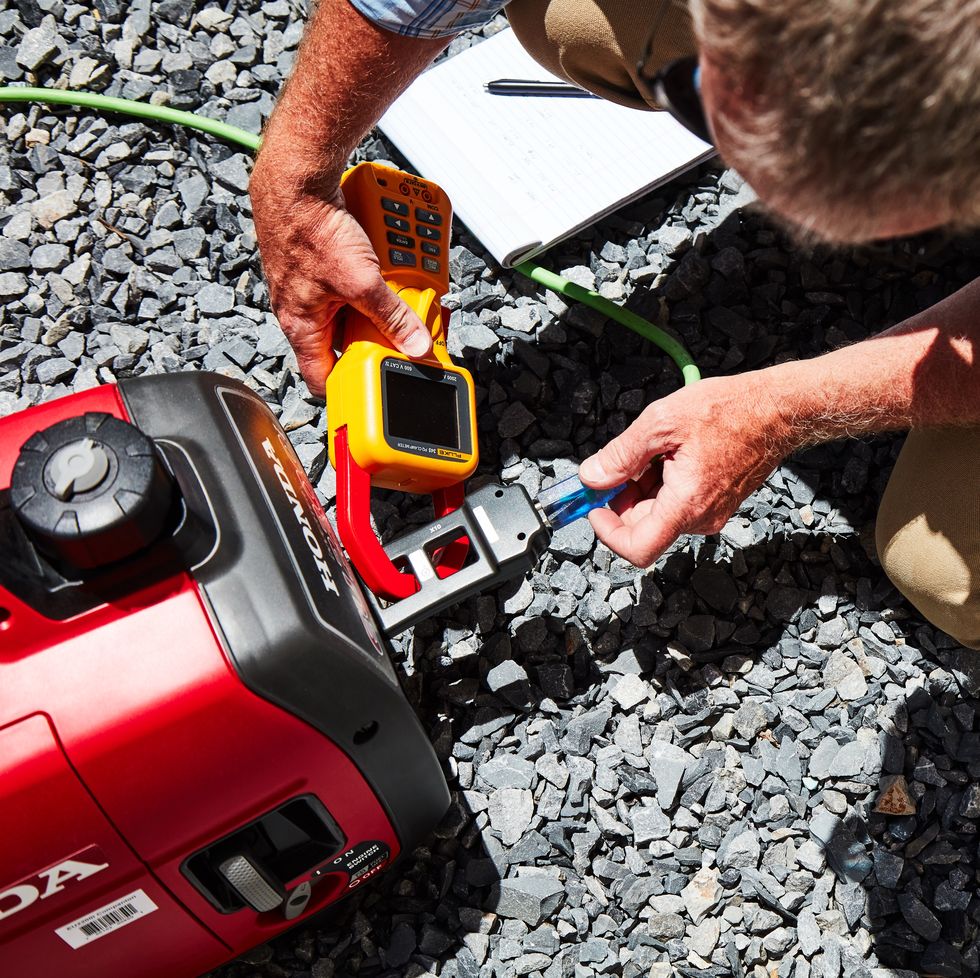
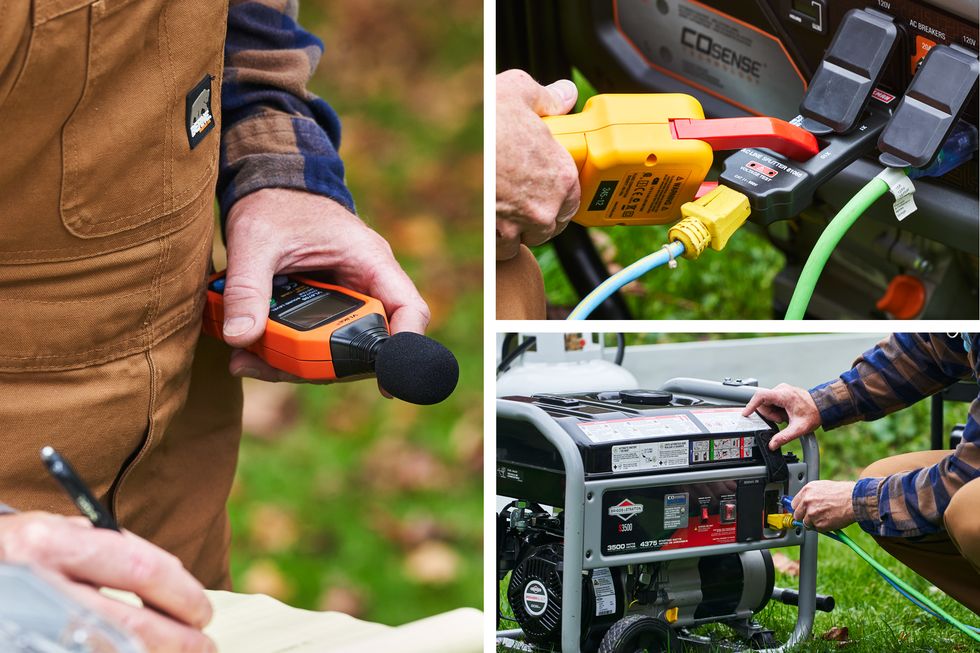
We measured the sound levels of these generators idling with no load, and while running under load at 2 feet and 25 feet. We used an oscilloscope to observe the sine wave of the AC current generated by these machines, and a clamp meter to check voltage output.
Some examples of devices we used with large starting and running loads include a large air conditioner and a portable table saw. We evaluated these generators based on ease of starting, power response, sound levels, value, safety, and reliability to select the top performers.
In addition, we included a few untested models in this roundup that have compelling prices, design, or other features that may meet your needs. These include the DuroMax XP1200, Westinghouse WGen7500, and Champion 4,750-Watt. We recommend these based on our experience testing and reviewing other similar models, research into the market, and consulting reviews that customers have left on retailers’ sites. Although we can’t speak to their performance, they have compelling prices, designs, and features that may meet your needs.
Our Portable Generators Reviews
Best Overall
Honda EU2200i Companion Portable Generator
Now 12% Off
Pros
- Quiet operation
- Easy to move around

Key Specs
| Type | Inverter |
|---|---|
| Engine size | 121 cc |
| Starting | Manual recoil |
| Fuel | Gasoline |
| Fuel capacity | 95 gal |
| Starting watts | 2,200 |
| Running watts | 1,800 |
| Decibels under load, 2/25 ft | 81.2/59.9 |
| Outlets | (1) 120 V, 20 A; (1) 120 V, 30 A twist lock |
| CO shut-off | Yes |
| Low oil shut-off | Yes |
| Weight | 46.5 lb |
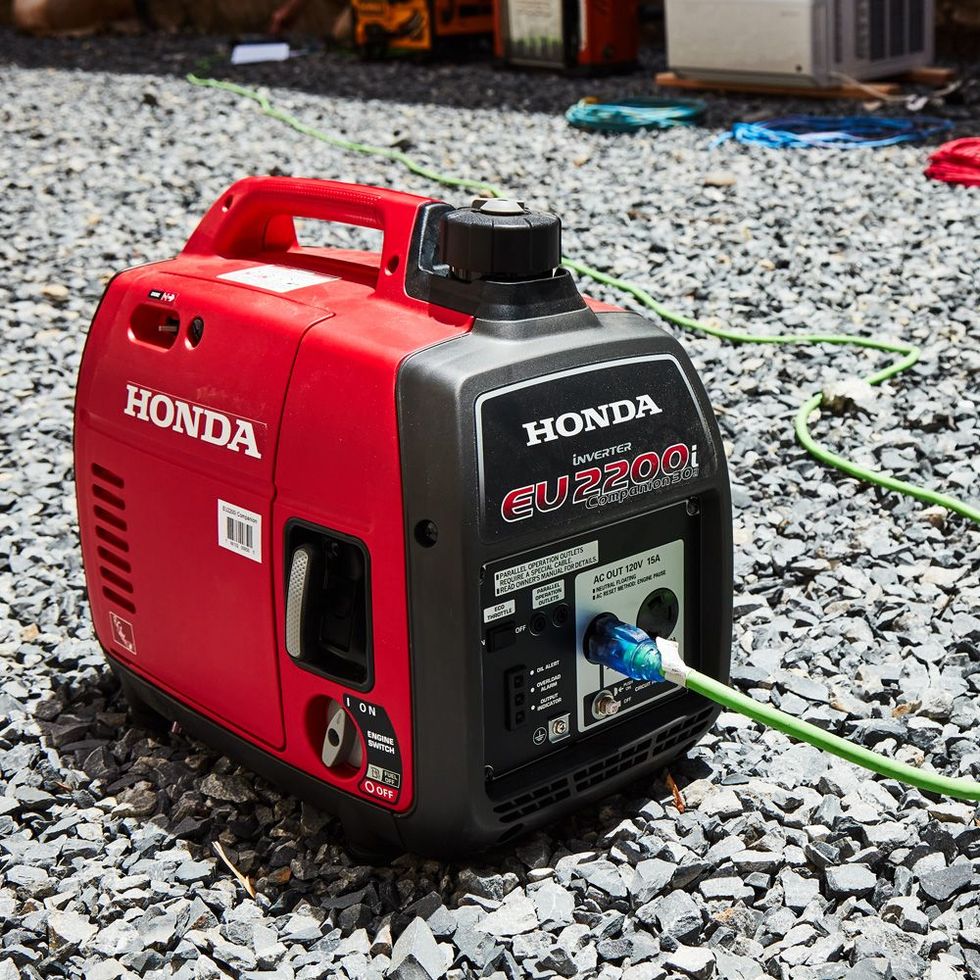
At half the size and less than half the weight of the other models in this test, the Honda EU2200i inverter generator is the most portable of the units we tested. It’s easy to pick up, move around, or pack in a vehicle—and since the generator is fully enclosed, it can slip into tight spaces without getting caught on anything.
That enclosure is an important feature, as it protects the inverter electronics and helps contain noise—the EU2200i is remarkably quiet. In testing, we measured sound levels of 68.9 decibels at the generator under no load. When we switched it to “eco” mode, which reduces engine speed when power isn’t called for, sound was reduced to 76 decibels.
When we used an oscilloscope to look at the sine wave of the current generated, the curves were smooth and symmetrical, an indicator of “clean” power required by sensitive electronics. When we started and stopped things with bigger motors, like a table saw and air conditioner, the sine wave remained smooth. Running under these heavier loads, we measured the highest sound levels for the EU2200i at 81.2 decibels at the generator.
Aside from the clean enclosure, there are some other nice features on this generator. The vent on the gas cap can be closed, so that fumes, or fuel, cannot escape. This means that it can be packed in a passenger compartment of an SUV without having to worry about fumes or fuel leeching into the cabin. Likewise, the power on/off switch doubles as a fuel shutoff so it can’t be forgotten.
Lastly, the EU2200i has ports for parallel operation. With the correct cable, it can be connected to a second EU2200i to double output to 4400 starting and 3600 running watts. The EU2200i is ideal for camping and other outdoor events where generator noise might be frowned on.
Here’s a sample list of appliances the EU2200i can run simultaneously: a refrigerator, a box fan, four CFL lights, a radio, an LCD TV, a laptop, and a charger for a mobile device.
Best Value
Champion Power Equipment 4,750-Watt Dual-Fuel Portable Generator
Pros
- Dedicated RV receptacle
- Runs on gas or propane
Cons
- No 240-volt outlets

Key Specs
| Type | Standard |
|---|---|
| Engine size | 224 cc |
| Starting | Electric/Manual recoil |
| Fuel | Gasoline, propane |
| Fuel capacity | 3.4 gal (gas) |
| Starting watts | 4,750 |
| Running watts | 3,800 |
| Decibels under load, 2/25 ft | 68 |
| Outlets | (2) 120 V, 20A; (1) 120 V, 30A twist lock; (1) 120 V, 30 A RV |
| CO shut-off | No |
| Low oil shut-off | Yes |
| Weight | 119 lb |
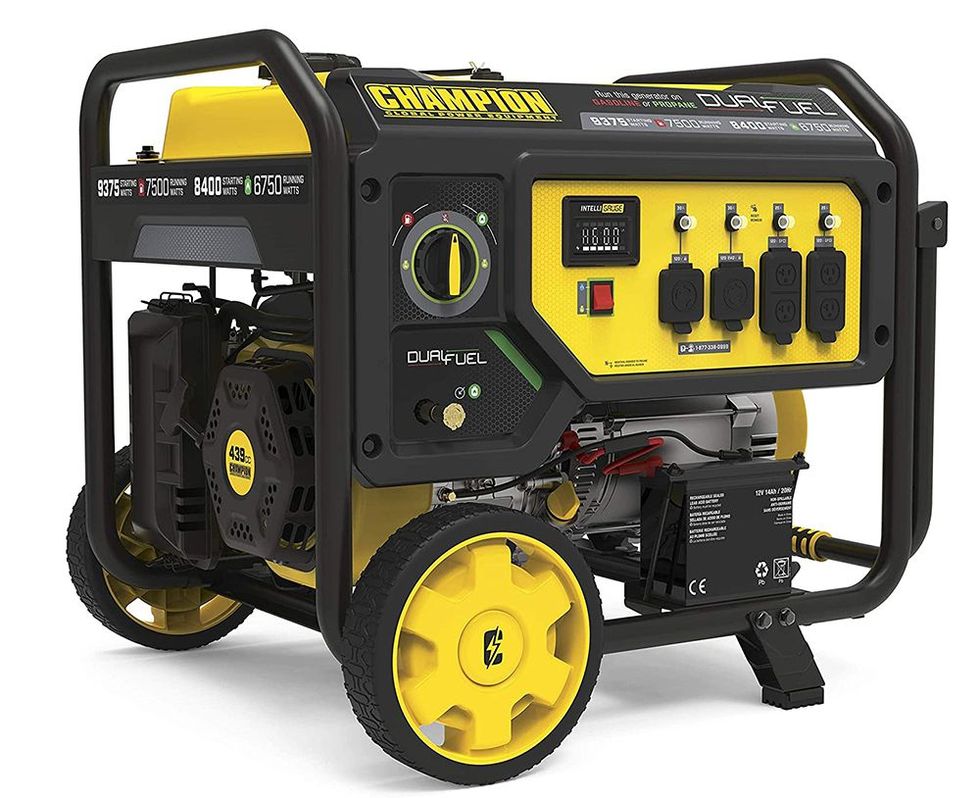
Champion’s 4,750-watt generator has enough capacity to run three or four critical 120-volt circuits in your home during an outage. It will also power small-to-medium campers and RVs via a dedicated 30-amp, 120-volt RV receptacle.
And, since it’s dual-fuel, you can run it off the camper’s propane without having to pack and haul a gas can. There are no 240-volt outlets, though, so if you need that many volts to power circuits in your home, this model won’t be right for you. Like other Champion dual-fuel generators, this one includes the adapter hose to hook up a 20-pound propane tank.
Best Capacity
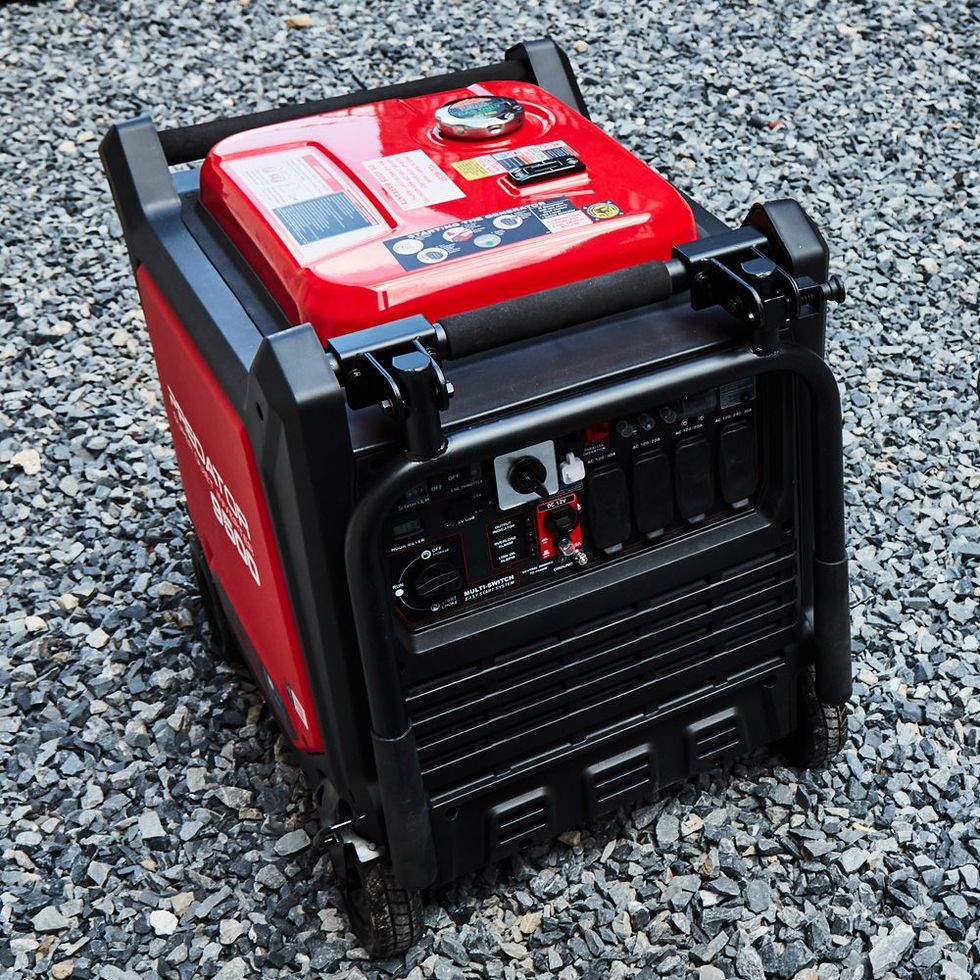
Predator 9500-Watt Inverter Portable Generator
Pros
- Lots of power
- Comes with plugs to make up cables
Cons
- Heavy
Key Specs
| Type | Inverter |
|---|---|
| Engine size | 459 cc |
| Sytarting | Electric, manual recoil |
| Fuel | Gasoline |
| Fuel capacity | 6.8 gal |
| Starting watts | 9,500 |
| Running watts | 7,600 |
| Decibels under load | 89.1 |
| Outlets | (1) 12 V DC; (2) USB; (4) 120 V, 20 A; (1) 120 V, 30 A; (1) 120/240 V, 30 A twist lock |
| Ground | Bonded neutral |
| CO shut-off | Yes |
| Low oil shut-off | Yes |
| Weight | 257 lb |
The Harbor Freight Predator 9500 is a large inverter, capable of powering all the critical circuits in a modest-size home. With a generator this size, we can’t overstate the importance of the four wheels it sits on and the sturdy, fold-out handle that facilitates moving it. We were able to pull it around fairly easily with one person, but lifting it was definitely a team affair.
To hit the running capacity, we powered two air conditioners, a portable heater, a table saw, and a planer. Despite the slew of devices it can run, we were able to easily have conversations around the generator; it’s that quiet. Finally, the Predator comes with two plug ends for 120-volt, 20-amp outlets and one 240-volt, 30-amp twist lock, in case your cables don’t match up or need converting—handy if you buy the 9500 in an emergency and get home to find your plugs don’t match. While it costs a lot, we believe this generator is worth the money considering how much if provides.
Here’s a sample list of appliances the Predator 9500 can run simultaneously: a refrigerator, a microwave, an electric water heater, a 12,0000BTU air conditioner, four CFL lights, an LCD TV, and a laptop.
Most Rugged
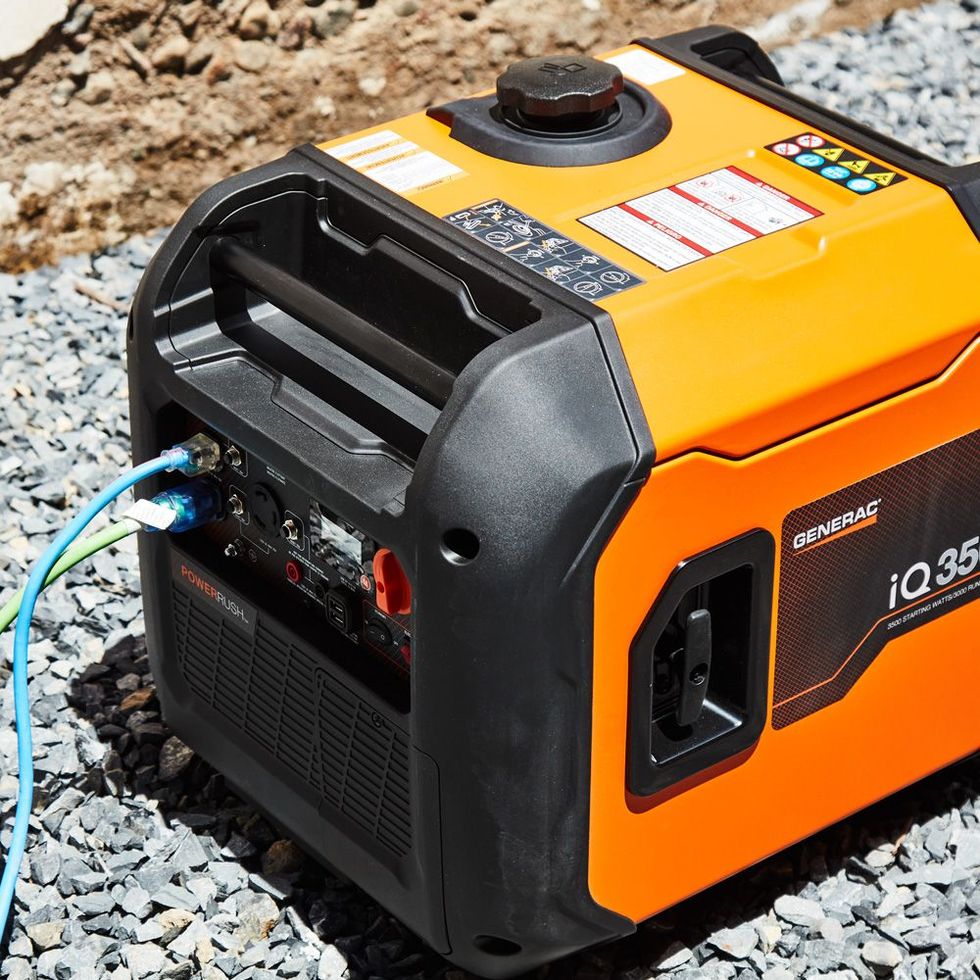
Generac iQ3500 3,500-Watt Inverter Portable Generator
Key Specs
| Type | Inverter |
|---|---|
| Engine size | 212 CC |
| Starting | Electric, manual recoil |
| Fuel | Gasoline |
| Fuel capacity | 2.6 gal |
| Starting watts | 3,500 |
| Running watts | 3,000 |
| Decibels under load, 2/25 ft | 83.2 |
| Outlets | (2) USB; (2) 120 V, 20 A; (1) 120 V, 30 A twist lock |
| Ground | Floating neutral |
| CO shut-off | No |
| Low oil shut-off | Yes |
| Weight | 109.1 lb |
Coupled with two sturdy handles, the metal doors and enclosure of the IQ3500 make clear that it’s a durable, well-built machine. We appreciated the convenience of the push-button electric start.
During testing, we used two 120-volt loads—our 15-amp table saw and a 10-amp portable air conditioner. While turning the saw on and off, the sine wave of the current had consistent symmetrical waves.
We were initially disappointed to see there’s no fuel gauge on the tank, but the LCD screen made it easy for us to monitor performance and keep tabs on remaining fuel and run time. The IQ3500 is a great compact generator for job sites and emergency home backup.
Here’s a sample list of appliances this Generac generator can run simultaneously: a refrigerator, a coffee maker, four CFL lights, an LCD TV, a laptop, and a charger for a mobile device.
Best For RV Camping
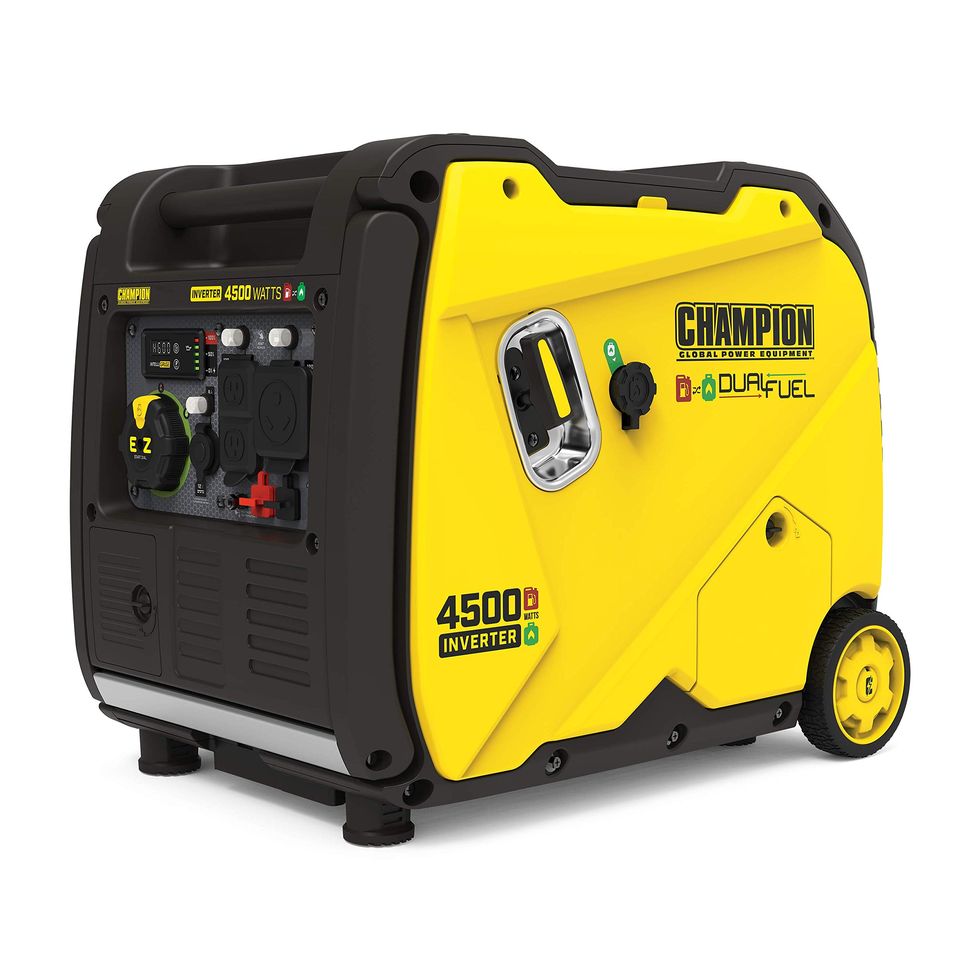
Champion Power Equipment 4,500-Watt Dual Fuel Inverter Portable Generator
Pros
- Runs on either gas or propane
Cons
- Needs an adapter to use with transfer switch
Key Specs
| Type | Inverter |
|---|---|
| Engine size | 212 cc |
| Starting | Electric, manual recoil |
| Fuel | Gasoline, propane |
| Fuel capacity | 2.3 gal |
| Starting watts | 4,500 |
| Running watts | 3,150 (propane); 3500 (gasoline) |
| Outlets | (1) 12V DC; (2) 120V, 20A; (1) 120 V, 30 A RV |
| CO shut-off | No |
| Low oil shut-off | Yes |
| Weight | 97 lb. |
This is an updated version of our best for RV camping pick, and while it offers slightly lower peak and running wattage, it otherwise has much of the previous model’s attributes. It has the same outlets, including a 30-amp RV-style plug and two household outlets. Also like that older model, it can run on either gas or propane.
With a full 2.3-gallon fuel tank, should be able to run for up to 14 hours. With a full 20-pound propane tank, this generator can supply 21 hours of uninterrupted power.
In addition to being a solid companion for camping and RVing, this generator could serve as a useful tool in an emergency situation where power is needed, owing to its ability to run on either gas on propane.
Most Versatile
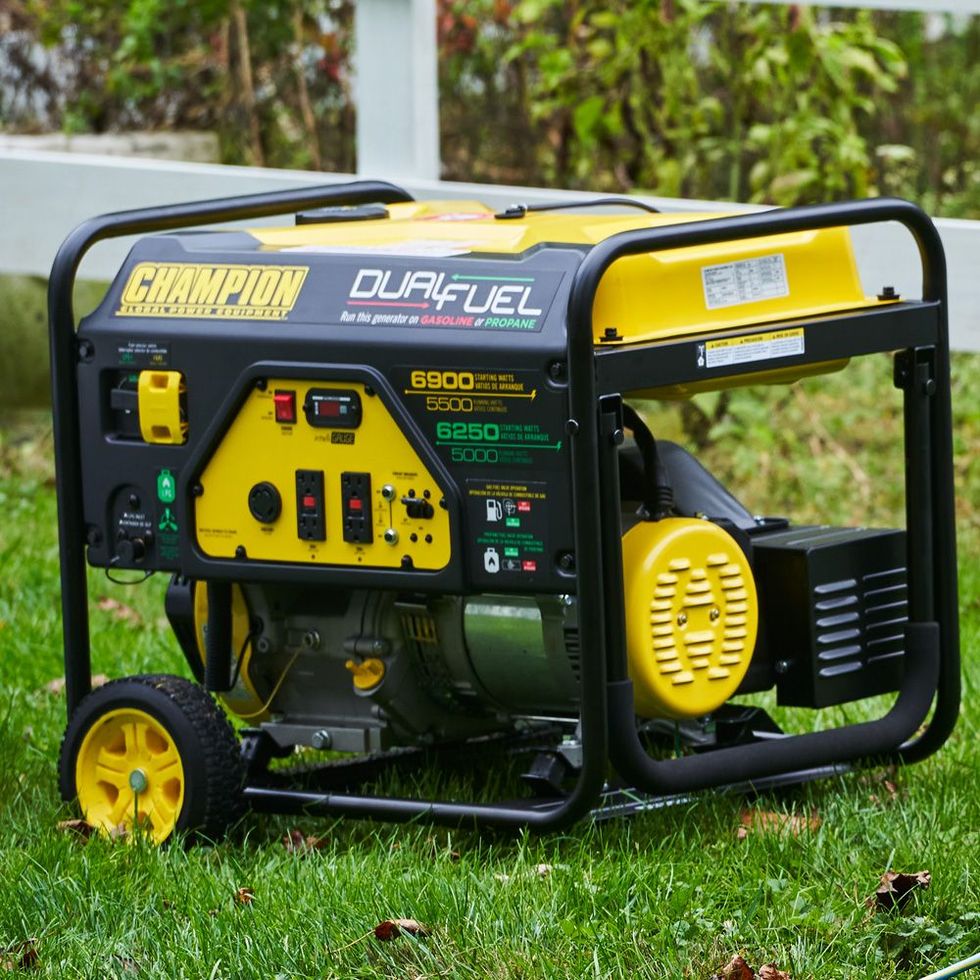
Champion Power Equipment 5,500-Watt Dual Fuel Generator
Pros
- Can run on gasoline or popane
Key Specs
| Type | Standard |
|---|---|
| Engine size | 389 cc |
| Starting | Manual recoil |
| Fuel | Gasoline/Propane |
| Fuel capacity | 6 gal |
| Starting watts | 6,900 (gas), 6,250 (propane) |
| Running watts | 5,500 (gas), 5,000 (propane) |
| Decibels under load, 2/25 ft | 93.8/87.2 (gas), 93.4/86.2 (propane) |
| Outlets | (4) GFCI 120 V, 20 A; (1) 120/240 V, 30 A twist lock |
| CO shut-off | No |
| Low oil shut-off | Yes |
| Weight | 162 lb |
Choose your fuel, or use what’s available in an emergency, with Champion’s 5,500 watt Dual Fuel generator. Being able to pick between gasoline and propane has a couple of benefits, especially when using a generator for backup power during or after storms.
Unlike gasoline, propane is stable and won’t gum up carburetors or other components when stored for long periods between use. Additionally, you might not have to deal with gasoline shortages following regional storms that take down power grids for days.
We found switching between gasoline and propane to be simple, and the Champion 5,500 started equally well on either fuel. However, since propane doesn’t pack the same amount of energy as gasoline, the running and starting watts were slightly reduced. We also confirmed that it runs just a little quieter on propane, with 78.2 decibels under load at 25 feet versus 81.5 decibels on gas.
One note on using propane: The main power switch on the panel won’t shut the unit down— the propane switch on the fuel selection panel shuts off both the flow of propane and the generator. This prevents the propane from being left on when the generator is off.
We appreciated the digital gauge at the top of the control panel that displays the voltage and current frequency being generated, as well as total hours of use—handy to keep track of maintenance schedules. The 5,500 Dual Fuel is a great option for emergency backup power, but it’s also good for job sites and bigger RVs and campers.
Here’s a sample list of appliances this Champion can run simultaneously: a refrigerator, a microwave, a Keurig machine, a 10,000-BTU air conditioner, four CFL lights, an LCD TV, a laptop, and a space heater.
The biggest generator we tested, Generac’s GP6500 COsense, boasts a generous starting capacity of 8,125 watts. This means the generator can handle startup loads from big appliances or tools that could be two- to three-times their running watts. Larger-capacity generators like this are particularly useful as backup power during power outages.
Connected to the home through a manual transfer switch rather than running extension cords to individual appliances, the generator can run directly to the home’s critical circuits. This unit could also supply power at construction sites, or to large RVs that have significant power needs.
Wherever you use it, Generac’s COsense technology keeps people near it safe. When the unit detects high levels of carbon monoxide (CO) in the immediate area, it shuts down, preventing CO poisoning or death. We tested this feature by placing a large cardboard appliance box over the unit while running and found that it shut off in just 16.5 seconds.
For a larger generator, the GP6500 isn’t excessively loud; we logged sound levels at 83.3 decibels under load from 25 feet away. When we hooked up an oscilloscope and monitored the sine wave of the current generated, we noticed some mild distortion, which is normal for most AC generators. It is a reminder, though, that if powering sensitive electronics from a generator, to do so using a good power strip with a surge protector.
To ensure the unit won’t need frequent refueling, it has a large fuel tank that holds nearly 8 gallons—there’s also a fuel gauge designed into the top of the tank. A digital hour meter is included on the front panel to help track maintenance—as it approaches 100 hours and starts to blink, it’s time to change the oil. At 200, routine service is recommended.
Here’s a sample list of appliances the GP6500 can run simultaneously: a refrigerator, a microwave, an electric water heater, four CFL lights, an LCD TV, and a laptop.
Robust Home Backup
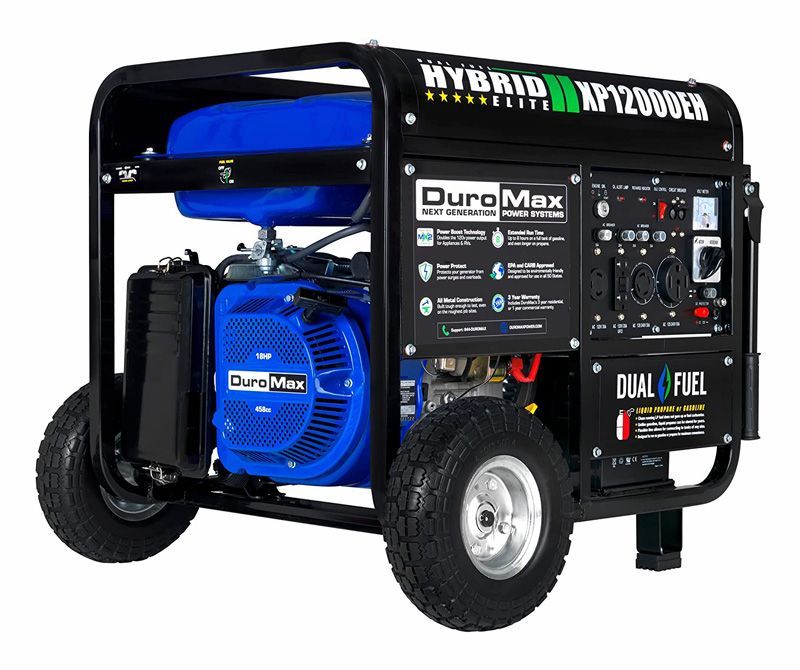
DuroMax XP12000EH Portable Generator
Pros
- Large capacity
- Electric start
Key Specs
| Type | Standard |
|---|---|
| Engine size | 457 cc |
| Starting | Electric/manual recoil |
| Fuel | Gasoline, propane |
| Fuel capacity (gas) | 8.3 gal |
| Starting watts | 12,000 |
| Running watts | 9,500 |
| Decibels | 74 |
| Outlets | (2) 120 V, 20 A; (1) 120 V, 30 A twist lock; (1) 120/240 V, 30 A twist lock; (1) 120/240 V, 50 A RV |
| CO shut-off | No |
| Low oil shut-off | Yes |
| Weight | 224 lb |
The DuroMax XP12000EH has a hardy 9,500-watt running capacity, with an extra 2,500 watts of starting capacity. These big numbers mean you’ll be able to run most—if not all— critical circuits in a modest-size home during a power outage.
The XP12000EH has electric start for convenience and can run on either gasoline or propane, which gives you more options for refueling in a pinch. And it has a 50-amp RV receptacle, so if you have a large camper you can run completely off-grid.
Whether you’re taking it on a camping trip or bringing it out of a shed for use during a power outage, this unit has wheels and a handle that make it relatively easy to tote around. The wheels are especially handy if you’re traveling with this generator—it weighs nearly 250 pounds, but with a sturdy ramp it shouldn’t be too difficult to load into or out of a vehicle.
FAQ With Test Editor Brad Ford

Brad Ford has spent most of his life using tools to fix, build, or make things. Growing up he worked on a farm, where he learned to weld, repair, and paint equipment. From the farm he went to work at a classic car dealer, repairing and servicing Rolls Royces, Bentleys, and Jaguars. Today, when he’s not testing tools or writing for Popular Mechanics, he’s busy keeping up with the projects at his old farmhouse in eastern Pennsylvania.
£


