


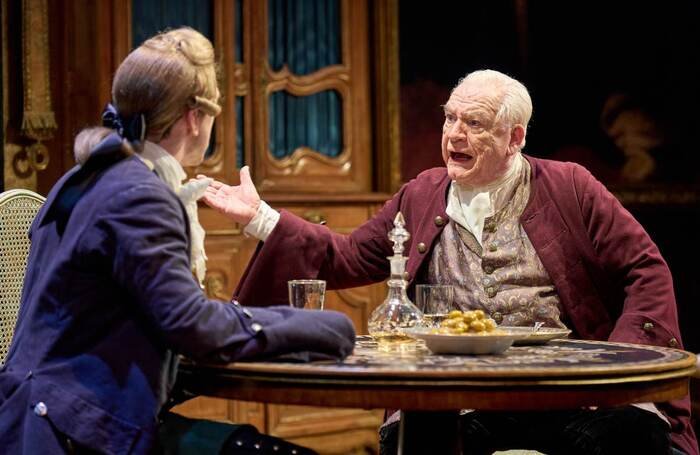
It was a crisp evening on February 27, 2025, when I took my seat at the majestic Theatre Royal Haymarket in London for the press night of The Score, a fresh theatrical offering penned by Oliver Cotton and brought to life under the seasoned direction of Trevor Nunn. This The Score review dives deep into a production starring Brian Cox as the legendary composer Johann Sebastian Bach, facing off against Stephen Hagan’s portrayal of Frederick II of Prussia. Set in 1747 Potsdam, this historical drama imagines a real-life meeting that sparked The Musical Offering, weaving a tale of ideological sparring between faith and power. With Cox riding high off his Succession fame and Nunn’s pedigree steering the ship, expectations soared. Did it hit the high notes? Here’s my comprehensive take on this period piece, running until April 26, 2025.
The Score Review: A Historical Premise Rich with Potential
The beating heart of The Score lies in a historical footnote ripe for dramatization: Bach’s visit to Frederick’s court in 1747, where the king—known as Frederick the Great—challenged the aging composer to improvise a fugue on a devilishly tricky theme. This The Score review finds Cotton’s script taking that spark and fanning it into a broader ideological blaze. Bach, a man of unshakable Lutheran faith and a pacifist at heart, squares off against Frederick, an Enlightenment-driven monarch with a penchant for war and a disdain for religion. It’s a clash of titans—art versus authority, spirituality versus secularism—that feels timeless, even if the play doesn’t always capitalize on its resonance with today’s world of strongmen and cultural divides.
The play opens in Leipzig, where Bach is reluctantly persuaded to travel to Potsdam. Here, we meet his wife Anna, played by Nicole Ansari-Cox (Cox’s real-life partner, adding a layer of authenticity), and their interactions brim with a playful, almost anachronistic wit. Bach’s grumbling about “kissing the king’s arse” lands a laugh, evoking shades of Blackadder, but it sets an uneven tone. This The Score review notes that the first act meanders, spending too long on domestic preamble—Bach’s fretting over travel, his health, his legacy—before the real drama kicks in at Frederick’s court. Once there, the stakes sharpen as Bach navigates a nest of sycophantic composers and a king eager to flex his intellectual muscle.
Historically, Frederick was a flute-playing dilettante who admired Bach’s genius but embodied a starkly different worldview. Cotton uses this tension to probe big questions: Can art thrive under tyranny? Does genius bend to power? This The Score review appreciates the ambition, though the script sometimes settles for surface-level jabs rather than a deeper excavation. Still, the premise alone makes it a worthy night at the theater.
The Score Review: Brian Cox’s Commanding Turn as Bach
No The Score review could skim over Brian Cox’s performance—it’s the gravitational pull of the production. As Bach, Cox is a colossus, his craggy features and resonant voice dominating the Haymarket stage. He crafts a Bach who’s both curmudgeonly and noble, a man whose faith is his armor and whose music is his sword. In one electrifying scene, he rails against Frederick’s war machine, his voice a thunderclap, his eyes burning with a zeal that could’ve been lifted from Logan Roy’s corporate tirades yet feels utterly authentic to the 18th-century composer.
But Cox’s brilliance isn’t just in the bombast. This The Score review treasures the quieter moments—like when Bach, weary from travel, is gently undressed by his son Carl (a poignant Jamie Wilkes), revealing a frailty that cuts through his bluster. Or when he faces Frederick’s musical challenge, his fingers twitching over an imaginary keyboard, a mix of disdain and inspiration flickering across his face. Cox makes Bach human—an artist wrestling with mortality, a father burdened by loss, a believer shaken by a godless world. He’s the reason to see The Score, a performance that lingers long after the curtain falls.
It’s worth noting Cox’s preparation, too. Reports suggest he immersed himself in Bach’s cantatas and fugues, not to play them (the production skimps on live music), but to embody their spirit. This The Score review applauds that dedication—it shows in every line, every gesture, making Bach not just a historical figure but a living, breathing soul.
The Score Review: Supporting Cast and Trevor Nunn’s Steady Hand
Stephen Hagan’s Frederick is a formidable adversary—part fop, part tyrant, all charisma. This The Score review relishes their confrontations, especially when Frederick unveils his fiendish theme, taunting Bach with a smirk that Hagan milks for all it’s worth. Their verbal sparring peaks in the second act, where Bach’s moral outrage meets Frederick’s icy pragmatism, a duel as gripping as any sword fight. Hagan nails the king’s duality—charming one moment, chilling the next—making him a worthy sparring partner for Cox.
The ensemble adds texture. Peter de Jersey’s Voltaire, Frederick’s philosophical guest, delivers sardonic zingers—like calling Prussia “an army with a state”—that land with a modern sting. The court composers—Quantz (Christopher Staines), Benda (Toby Webster), and Graun (Matthew Romain)—flutter about like nervous courtiers, their exaggerated deference a source of levity that sometimes overstays its welcome. Nicole Ansari-Cox’s Anna and Jamie Wilkes’s Carl ground the Leipzig scenes with warmth, though their roles feel underwritten.
Trevor Nunn, at 85, brings a veteran’s touch. This The Score review credits his staging for keeping the energy high, with Robert Jones’s set—an austere Leipzig home morphing into a lavish Potsdam palace—shifting fluidly via a revolve. Johanna Town’s lighting, all chiaroscuro and dramatic pools, heightens the mood, especially in the showdowns. Yet Nunn can’t fully mask the script’s bloat. At two hours and forty minutes with an interval, it’s a long sit, and this The Score review wonders if tighter editing could’ve sharpened the impact.
The Score Review: Oliver Cotton’s Script—Hits and Misses
Cotton’s writing is the wild card in this The Score review. It’s a script brimming with ideas—art’s autonomy, faith’s endurance, power’s corruption—but it doesn’t always harmonize them. The humor, like Bach’s quips about royal flattery, is a delight, yet it clashes with the heavier stakes, leaving the tone wobbly. This The Score review finds the modern parallels—Frederick as a proto-dictator—intriguing, but they’re more implied than explored, a missed chance to bridge 1747 and 2025.
The biggest head-scratcher is the lack of music. For a play about Bach, whose fugues and cantatas redefined Western sound, we get only faint harpsichord echoes. When Cox mimes playing, it’s more awkward than evocative—a pity, as even a snippet of The Musical Offering could’ve elevated the drama. This The Score review sees it as a baffling choice, one that dims the play’s soul. Cotton’s dialogue shines in bursts—Voltaire’s barbs, Bach’s tirades—but it’s padded with exposition, especially in Act 1, that tests patience.
Still, there’s craft here. The central conceit—Bach solving Frederick’s puzzle as a metaphor for outwitting his worldview—lands when it counts. This The Score review just wishes the script took more risks, diving deeper into its themes rather than skimming their surface.
The Score Review: Emotional Resonance and Untapped Depths
Does The Score move you? This The Score review says: not quite. Cox carries the emotional weight—his Bach is a man of passion and pain—but the play around him feels more intellectual than heartfelt. A subplot with servant Emilia (Juliet Garricks), grieving her soldier son, hints at war’s human cost, but it’s a fleeting note, drowned out by the main duel. The finale—Bach back at his music, Frederick unchanged—lacks a cathartic punch, ending on a diminuendo rather than a crescendo.
Compare this to Nunn’s past triumphs like Les Misérables, where every beat tugged the heartstrings, and The Score feels restrained. This The Score review sees potential in the Leipzig scenes—Bach’s family life could’ve been a richer counterpoint to Potsdam’s coldness—but they’re sidelined. It’s a play you admire more than feel, a cerebral exercise that leaves tears unshed.
Audience reactions, gleaned from whispers in the foyer, were mixed. Some raved about Cox—“worth every penny”—while others found it “a bit long.” This The Score review aligns with that split: it’s a showcase for talent, less so for emotion.
The Score Review: Context and Legacy
To fully appreciate The Score, this The Score review offers some context. Bach, by 1747, was in his twilight—nearing blindness, his fame overshadowed by his sons’ rising stars. Frederick, meanwhile, was at his peak, a king who’d turned Prussia into a military powerhouse. Their meeting was a collision of eras—Baroque giving way to Enlightenment—and Cotton’s play captures that shift, if imperfectly.
Nunn’s involvement adds heft. With a career spanning Cats to Nicholas Nickleby, he’s a theater titan, and The Score feels like a late-career flex—less revolutionary than his youth, but polished. Cox, post-Succession, brings a global spotlight, his every move dissected by fans expecting Logan Roy’s growl. This The Score review sees him defying typecasting, proving his range.
The production’s timing—amid London’s winter theater season—positions it against heavyweights like the National’s latest. This The Score review suspects it’ll draw crowds for Cox, though it may not linger in the canon like Nunn’s classics.
The Score Review: Final Thoughts and Verdict
So, where does this The Score review land? It’s a vehicle for Brian Cox, and he drives it with ferocity and finesse. Nunn keeps it humming, the cast sparkles, but Cotton’s script doesn’t soar as high. It’s lively, thought-provoking, and beautifully staged—yet it’s too long, too light on music, and too shy of emotional depths. This The Score review calls it a near-hit, not a home run.
For Cox alone, it’s a must-see. His Bach is a masterclass, a reminder of why he’s a stage legend. Hagan and the ensemble keep pace, and Nunn’s craft shines through. But as a whole, The Score feels like a promising draft—good, not great. Catch it at Theatre Royal Haymarket until April 26, 2025, and judge for yourself. This The Score review gives it a solid but not stellar mark.


