


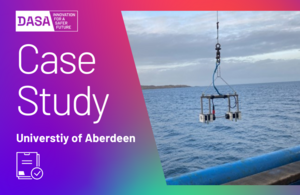
From Ship-Sized to Hand-Held
- DASA funding and Dstl technical advice has helped the University of Aberdeen develop the world’s most compact and lightweight underwater holographic camera – the weeHoloCam
- The holographic camera has vastly improved processing speed – what previously took months can now be done in hours
- Added AI integration enables the automatic classification of millions of marine particles in real-time
- The weeHoloCam’s evolution spans two DASA projects, the first focused on developing the camera and processor, the second project added AI classification capabilities
Plankton might be microscopic, but their importance to the planet is huge. These marine organisms produce half the world’s oxygen, form the foundation of ocean food chains, and play a crucial role in carbon absorption from the atmosphere. Marine biologists study plankton to better understand how the ocean’s food web is changing, and how climate change affects marine life. However, this process has always been a challenge – as traditional sampling methods are time-consuming and logistically difficult.
This was the reality for marine biologists until the University of Aberdeen, with DASA funding in 2019, revolutionised underwater imaging with their weeHoloCam.
“The holographic camera we used in the past was big in size and weighed more than 100 kilograms, making it very difficult to transport and deploy,” explains Dr. Thangavel Thevar from the School of Engineering, University of Aberdeen. “Now, with DASA funding, we have developed a very small version of the same that is 60 cm long and weighs just 3.5 kilograms – the frame for the camera is actually heavier than the camera itself!”
Technical Innovation
The weeHoloCam’s innovative design features two cylinders – one housing a pulse laser and optics while the other containing a sensor, mini-PC and electronics. “The camera can detect particles that are present between its windows, covering approximately 12 cm cube of water,” explains Dr. Thevar. “Within this volume, we can capture incredibly detailed holograms of particles as small as 50 microns.”
Breaking Speed Barriers
Using this advanced system, the team unlocked new capabilities in underwater imaging. “For example, in a single 3-hour dive, you can capture up to 200,000 holograms,” says Dr. Thevar. “Previously, processing each hologram took about two minutes, which meant 200,000 holograms will take more than 9 months to process.”
Using Field Programmable Gate Array (FPGA) technology, the team dramatically reduced the processing time. “We’ve taken the processing time down from two minutes to just two seconds per hologram. What would have taken 100 days now takes just one day.”
Adding AI Intelligence
Building on this, the University of Aberdeen embarked on a second project with DASA in 2022 to make the process even quicker by integrating an AI classification system for the particles. “As engineers, we needed to make this useful for biologists,” explains Dr. Thevar. “When you’re dealing with millions of individual images from hundreds of thousands of holograms, manual classification becomes incredibly time consuming.”
The new AI classifier automatically labels the images in real-time. As soon as a hologram is recorded through the camera, it’s processed and classified automatically.
Real-World Applications and Impact
The weeHoloCam has been deployed more than 20 times across various marine environments, including regular work with Marine Scotland. “We hope to support their weekly vessel deployments for plankton monitoring,” explains Dr. Thevar. “While traditional net sampling provides valuable data, our holographic camera adds crucial information about vertical depth distribution that nets can’t capture. This complementary approach gives us unprecedented insight into marine health.”
The system has even attracted media attention, featuring on BBC’s One Show during a deployment in Loch Ness. “While we did not find Nessie we were afforded a rare opportunity to study plankton in a freshwater situation which was a first for us,” says Dr. Thevar.
Loch Ness holographic camera hunt
From a defence and security standpoint, the WeeHoloCam project addresses a critical challenge in marine operations: monitoring microscopic sea life in real-time. This capability is essential for predicting harmful algal blooms and tracking changes in marine biomass that can affect underwater optical systems.
The innovation delivers two key advantages:
- Its compact size enables deployment on the growing fleet of Unmanned Underwater Vehicles, dramatically increasing measurement coverage
- Its advanced AI algorithms automatically classify micro-organisms, significantly reducing the manual analysis time needed to produce biological tactical assessments
End of DASA project trial
In October 2024, at the end of their DASA project, the University of Aberdeen demonstrated their subsea holographic camera to technical Dstl partners. The lab-based trials proved highly successful. The team showcased the system’s real-time classification capabilities, using both previously collected sea-trial data and live samples containing tiny jellyfish. The demonstration highlighted the intuitive user interface, which allows operators to easily select and group different marine organisms for analysis, from bubbles to dinoflagellates (a planktonic single-celled organism) and copepods (a group of very small crustaceans).
Future Horizons
The team is now running at full capacity with several exciting developments:
- Tackling sea lice detection in salmon farms, despite the challenging nature of identifying these sparse, elusive parasites
- A new funded project to permanently deploy a system for harmful micro-jellyfish detection
- Exploring mounting the technology on autonomous underwater vehicles
- Supporting carbon transport research by tracking organic matter movement in oceans
The DASA Difference
The University of Aberdeen credits DASA’s support for the project’s success. “Working with DASA has been a very positive experience,” notes Dr. Thevar. “It’s always a two-way conversation where we help each other. They’ve pushed us forward, whether through commercialisation ideas or project development, and have been instrumental in providing further leads to follow.”
“From studying plankton populations to tracking carbon transport in our oceans, this technology is helping us understand our marine environments in ways we never could before,” concludes Dr. Thevar. “And with each new application we discover, the value of DASA’s early investment becomes even more apparent.”